
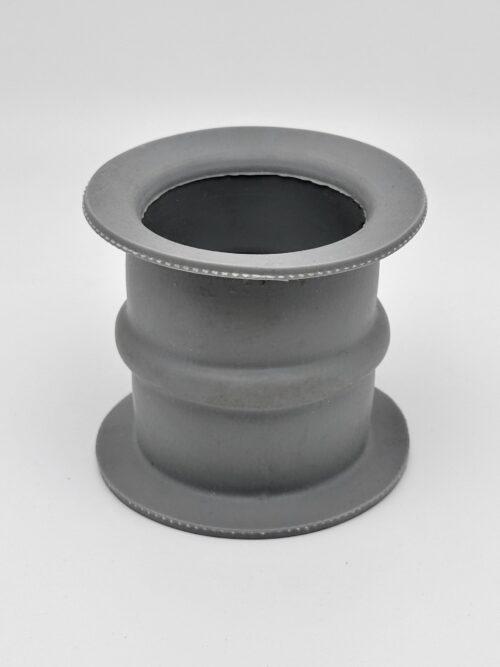
 Reinforced rubber combines elastomeric matrices with fabric or fiber reinforcements to produce custom-molded rubber components with enhanced resistance to mechanical stress, extreme temperatures, and chemically aggressive conditions. As a fiber-reinforced composite, these materials are engineered for applications where standard elastomers fall short.
RD Rubber Technology Corporation engineers and manufactures reinforced rubber parts for defense, aerospace, MedTech, space exploration, food processing, and dairy processing industries. Learn more about our reinforced rubber material specifications, high-performance elastomer and fabric options, and our engineered-quality capabilities.
Material Specifications for Reinforced Rubber
Applications for Critical-to-Function Environments
Fabric-reinforced rubber is specified when unreinforced elastomers lack the dimensional stability or load-bearing capacity the application demands. Common critical-to-function use cases for our fabric-reinforced rubber components include:
- Aerospace and defense seals and rubber diaphragms. Mission-critical seals and rubber diaphragms maintain seal integrity under high-frequency pressure cycling and vibration.
- Space-rated bellows and boots. Precision-molded for extreme thermal stability. Dimensional accuracy is verified via FARO Arm CMM technology to meet critical load-bearing and performance standards.
- MedTech and pharmaceutical-grade components. High-purity seals designed to maintain mechanical integrity through repeated sterilization cycles and aggressive chemical exposure.
- Food and dairy processing parts. FDA-compliant components built to withstand harsh wash-down chemicals and extreme temperature fluctuations without degradation.
- Military-grade grommets, gaskets, and more. Full Mil-Spec compliance with advanced 3D scanning capabilities to provide precision reverse engineering for obsolete or legacy system parts.
Technical Properties
| Property | Typical Range |
|---|---|
| Tensile Strength | 1,500 - 3,500 psi (depending on elastomer/fabric combination) |
| Elongation at Break | 100 - 400% |
| Hardness (Shore A) | 40 - 90 |
| Temperature Range | -65 °F to 450 °F (varies by elastomer compound) |
| Chemical Resistance | Excellent (compound-dependent) |
| Pressure Rating | High-fabric-layer resists burst and creep |
| Dimensional Stability | Superior vs. unreinforced thermoset elastomers |
Mechanical Advantages
Fiber-reinforced composites deliver performance characteristics that influence both part life and system reliability:
- Burst resistance. The fabric layer prevents catastrophic failure under sudden pressure spikes.
- Creep resistance. Reinforced construction maintains dimensional tolerance under sustained load—critical for sealing applications.
- Tear resistance. Fabric integration significantly increases resistance to tear propagation.
- Fatigue life. Reinforced rubber sustains more flex cycles before failure than equivalent unreinforced compounds.
- Anisotropic control. Fabric orientation can be engineered to direct strength where the application demands it.
These properties make reinforced rubber the preferred choice when engineers need a component that holds its geometry and function over the full service life of the assembly.
High-Performance Elastomers and Aramid Materials for Fabric-Reinforced Rubber Components
Engineering high-performance custom reinforced rubber components requires a deep understanding of interfacial bonding between polymer matrices and technical textiles. RD Rubber leverages aramid fabric reinforcements to solve the most demanding thermal and mechanical challenges in Aerospace, Defense, and MedTech. By integrating materials like Kevlar® and Nomex® into custom-molded components, we provide the durability needed for high-pressure and extreme-temperature environments.
Optimal Thermoset Elastomers for Reinforced Rubber Component Manufacturing
The elastomer matrix determines chemical compatibility, temperature range, and dynamic performance in a given application. Common thermoset elastomers used in reinforced rubber components include:
- EPDM. UV, ozone, and weather resistance; aerospace exterior applications.
- Nitrile (NBR/Buna-N). Fuel and oil resistance; industrial and food-contact environments.
- Viton®/FKM/Fluoroelastomer. High-temperature and chemical resistance; defense, aerospace, and pharmaceutical applications.
- Neoprene. Weathering and flame resistance; marine and military use.
- Silicone/Liquid silicone. Wide temperature range; medical and cleanroom-compatible.
- Fluorosilicone. Fuel resistance with silicone’s temperature range; electronics and aerospace.
Thermoset elastomers cure to a cross-linked state, providing dimensional and thermal stability suited to critical-to-function environments.
High-Strength Aramid Fabric Used in Reinforced Rubber Component Manufacturing
The performance of a reinforced rubber component depends on the mechanical bond between the elastomer matrix and the technical textile. At RD Rubber, we optimize this interface to ensure that the tensile strength of the fiber translates into the burst resistance and dimensional and thermal stability of the final molded part. Below is a comparison between the three types of aramid fiber reinforcements we use:
| Reinforcement Fiber | Performance Attributes | Common Applications | Advantage |
|---|---|---|---|
| Kevlar® (para-aramid) | Exceptional tensile strength; high modulus; low weight; flame resistant | High-pressure diaphragms; aerospace seals; ballistic shielding | Highest burst resistance for thin-walled components |
| Nomex® (meta-aramid) | Superior thermal stability; excellent chemical resistance; will not melt. | Aerospace ducting; engine heat shields; high-temp gaskets. | Maintains structural integrity in extreme ambient heat. |
| Nomex® & Kevlar® Blend | High strength & thermal stability; "non-break-open" protection; resists thermal shrinkage | Aerospace engine components; safety-critical expansion joints; fire-resistant diaphragms | Combines the burst resistance of Kevlar with the non-melting stability of Nomex for superior performance |
Ply count, weave, and fiber orientation are specified during the engineering phase to meet the mechanical targets defined in the component drawing.
Frequently Asked Questions (FAQs): Reinforced Rubber Material Selection
How does reinforcement affect mold design?
Fabric layers require adjustments to tooling geometry and cure cycle parameters, including ply placement, compression ratios, and flow dynamics.
Which certifications apply to reinforced rubber components in aerospace and defense programs?
Our facility is certified to ISO 9001:2015 and AS9100:2016, ITAR registered, and Department of Defense (DOD) Joint Certification Program (JCP) certified. Products are manufactured to Mil-Spec and ASTM standards where specified.
Can RD Rubber produce reinforced rubber components for cleanroom environments?
Yes. Our ISO 14644 Class 8 cleanroom supports production for medical, pharmaceutical, and biopharmaceutical applications.
What is fabric-reinforced rubber?
Fabric-reinforced rubber is a composite of one or more aramid fabric layers bonded within or around an elastomeric compound, adding tensile strength, tear resistance, and dimensional stability to rubber products.
Choose Engineered-Quality Custom Fiber-Reinforced Rubber Components from RD Rubber
Since 1986, RD Rubber has engineered and manufactured custom-molded rubber components using thermoset elastomers and reinforced rubber for defense, aerospace, space exploration, MedTech, and food processing industries. We are a domestic manufacturer based in California which enables reduced logistics risks and ensures timely delivery for our customers. Our rubber molding capabilities include rubber compression molding, rubber-to-metal bonding, injection molding, liquid silicone rubber (LSR) molding, insert molding, transfer molding, and more.
We bring a high caliber of quality and consistency to every project, backed by our certifications, registrations, and testing capabilities:
- ISO 9001:2015 certification
- AS9100:2016 certification
- ITAR registration
- Department of Defense (DOD) Joint Certification Program (JCP) certification
- NIST 800-171 compliance
- ISO 14644 Class 8 cleanroom
Our testing and inspection capabilities include:
- Material Validation: Utilizing Moving Die Rheometer (MDR) testing to ensure every batch of material meets the specific curing and performance requirements of the design.
- Advanced Inspection: We utilize FARO Arm CMM technology to verify the dimensional integrity of complex geometries, ensuring that reinforced bellows and seals meet strict aerospace tolerances.
Utilizing the scanning capability of our FARO Arm CMM, we also provide reverse engineering for legacy parts that may be out of production or if a part’s technical drawings are no longer available. This service has been invaluable especially for our customers in the aerospace and defense industry.
To discuss your reinforced rubber application or for a technical consultation, contact us today. Or request a quote for your next project.